Organizations often assume leadership challenges are primarily about technical capability, intelligence, or industry expertise. Yet research across thousands of leaders, and more importantly, our experience suggests something very different. The most significant leadership challenges are not usually about knowledge. They are about alignment, influence, execution, adaptability, trust, communication, and the ability to lead increasingly complex systems.
What becomes clear is this: leadership challenges evolve as leaders move through the organization. At bluSPARC, we see these same patterns repeatedly through executive coaching, Organizational Performance Surveys (OPS), leadership assessments, and executive team strategy sessions.
Leadership Challenges Change as Leaders Advance
Early in a career, leaders are often rewarded for technical expertise and personal performance. As they move upward, however, success depends less on what they can personally accomplish and more on how effectively they influence, align, and develop others.
Leadership becomes progressively less about individual contribution and increasingly about organizational contribution.
At different levels, leaders tend to face different dominant challenges:
- Frontline leaders struggle with delegation, feedback, accountability, and transitioning from peer to manager.
- Mid-level leaders often wrestle with developing their teams, cross-functional influence, competing priorities, organizational silos, and stakeholder management.
- Senior leaders face challenges tied to strategic alignment, enterprise thinking, execution discipline, and strategic alignment
- Executives increasingly operate within ambiguity, systems complexity, market disruption, leading change, and organizational culture dynamics.
This progression matters because many organizations continue developing leaders primarily through technical training rather than leadership system development. One of the most important transitions in leadership occurs when leaders realize their role is no longer simply managing work. Their responsibility becomes creating the conditions where people, teams, and systems can perform effectively together. It is working through others to achieve organizational goals and individual actualization.
As leaders advance and organizations become more interconnected, leadership increasingly depends on the ability to influence beyond formal authority. Many leaders today are accountable for outcomes they do not directly control. This is particularly true in as organizations are driving strategic alignment, high-growth, and environments experiencing rapid change.
This creates several common challenges:
- Leading across silos
- Navigating competing agendas
- Building cooperation between functions
- Influencing peers
- Aligning stakeholders with different priorities
- Driving execution through collaboration rather than hierarchy
The leaders who succeed are often not the loudest or most authoritative. They are the leaders who can create clarity, alignment, trust, and momentum across complex systems.
Awareness Is Foundational to Organizational Performance
One of the most important factors in leadership and organizational effectiveness is awareness. Organizations improve performance when leaders, teams, and the broader enterprise develop a clearer understanding of what is working, what is misaligned, and where performance barriers exist.
Many organizational challenges are not immediately visible on the surface. Issues involving alignment, communication, accountability, decision-making, trust, adaptability, execution, and cross-functional cooperation often emerge gradually over time and become embedded in how the organization operates. Similarly, leaders and teams may develop blind spots around how their behaviors, decisions, and interactions affect others and impact organizational performance.
This is why leadership assessments, organizational diagnostics, team effectiveness tools, and feedback systems are so valuable. They create visibility into patterns that are often difficult to see from inside the system itself. More importantly, they create the awareness necessary for meaningful leadership development, organizational alignment, and sustained performance improvement.
At bluSPARC, we use integrated assessments and diagnostics across the individual, team, and organizational levels to help leaders better understand both leadership capability and organizational effectiveness. These include:
- 180 Alignment Assessments creates structured conversations between leaders and managers around leadership expectations, competencies, and development priorities.
- D.R.I.V.E.S. Team Effectiveness Assessment evaluates how effectively teams create direction, build relationships, integrate across functions, generate value, execute with discipline, and steward accountability.
- The Organizational Performance Survey (OPS) measures the organizational conditions that drive performance, including alignment, execution, collaboration, adaptability, leadership effectiveness, and culture.
- 360 Feedback Assessments that provide leaders with multi-perspective feedback from managers, peers, direct reports, and stakeholders.
- Hogan Assessments that help leaders understand personality patterns, leadership strengths, derailment risks, and behavior under pressure.
- Workplace Big Five Profiles that provide insight into communication styles, decision-making preferences, and team interaction dynamics.
When combined with coaching, facilitated dialogue, and leadership development, these tools become more than assessments. They become catalysts for greater awareness, stronger alignment, better decision-making, and improved organizational performance.
Leadership Development Must Strengthen the Entire Leadership System
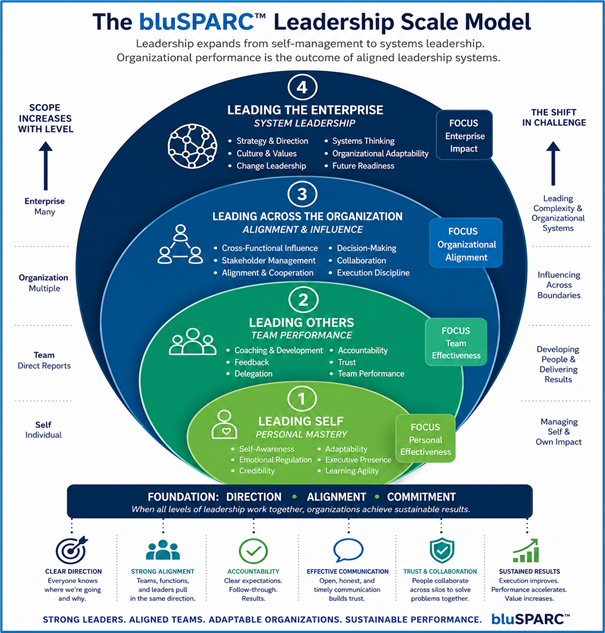
Leadership development should not simply focus on improving individuals. It must also strengthen the broader leadership system in which leaders operate. As illustrated in the bluSPARC Leadership Scale Model, leadership effectiveness expands as leaders move from managing themselves, to leading teams, to aligning organizations, and ultimately to leading enterprise systems. At each level, the leadership challenge becomes more interconnected, strategic, and organizational in nature.
The foundation begins with Leading Self. Before leaders can effectively influence others, they must first understand how they communicate, make decisions, manage pressure, and build credibility. Self-awareness, adaptability, emotional regulation, and accountability create the personal foundation for effective leadership. Leaders who lack this foundation often struggle to create consistency, trust, and stability for others.
As leaders become responsible for teams, the challenge expands from personal effectiveness to creating performance through people. Leading Others requires leaders to move beyond individual contribution and begin developing accountability, trust, coaching capability, delegation, and team performance. This transition is significant because many leaders are promoted for technical expertise but are later expected to create results through collaboration, development, and influence. Strong teams do not happen accidentally. They are shaped by leaders who create clarity, feedback, ownership, and follow-through.
As leadership scope expands further, leaders must begin Leading Across the Organization. Success increasingly depends on cross-functional collaboration, stakeholder alignment, decision-making, and the ability to reduce silos across the enterprise. Leadership becomes less about authority and more about influence, it is aligning systems, priorities, and decisions across the organization.
This ultimately expands into Leading the Enterprise, where leaders shape the organizational systems that can adapt, grow and drive long-term performance. Enterprise leaders are shaping the systems that align strategy, culture, execution, adaptability, and future readiness while creating the conditions that allow the organization to grow and sustain performance over time.
Effective organizations intentionally connect leadership capability, team effectiveness, organizational alignment, execution discipline, and strategic adaptability into one integrated leadership ecosystem. Leadership is therefore not separate from organizational performance. Leadership creates the conditions that shape organizational performance.
When leadership systems are aligned across all levels, organizations gain clearer direction, stronger alignment, better decision-making, greater accountability, stronger collaboration, and more sustainable execution. This is why leadership development must evolve beyond isolated training programs and become part of a broader organizational performance and leadership systems strategy.
Leadership Development Must Drive Organizational Performance
Leadership development is most effective when it improves not only individual capability, but organizational performance. Organizations do not achieve stronger execution, alignment, accountability, collaboration, or adaptability simply because leaders attend training programs. These outcomes improve when leaders learn and consistently apply the leadership practices that strengthen how the organization functions as a system.
Effective leadership development equips leaders with practical tools and capabilities that directly influence organizational outcomes, including:
- creating strategic clarity and alignment,
- improving decision-making and accountability,
- strengthening cross-functional collaboration,
- developing talent and future leaders,
- leading change more effectively,
- and increasing execution discipline across teams and functions.
As leaders expand from Leading Self, to Leading Others, to Leading Across the Organization, and ultimately Leading the Enterprise, the impact of their leadership increasingly shapes organizational culture, coordination, adaptability, and performance.
This is why effective organizations intentionally connect leadership development to broader organizational systems through tools such as executive coaching, 180 and 360 feedback, team effectiveness assessments, organizational diagnostics, strategic offsites, and leadership learning journeys. These tools help leaders build the awareness, alignment, communication, and execution capabilities required to improve organizational outcomes over time.
Leadership is therefore not separate from organizational performance. Leadership creates the conditions that drive organizational performance.
The Real Leadership Challenge: Leading Organizational Complexity
Perhaps the greatest leadership challenge today is leading effectively within increasing organizational complexity of simultaneously executing creating a vision and priorities while preparing for tomorrow’s disruptions, aligning stakeholders while creating a coherent vision when there is ambiguity and building trust as interconnections across systems and teams increases. As organizations grow more dynamic and interdependent, leadership becomes less about controlling activity and more about creating alignment, adaptability, coordination, and clarity across complexity.
This requires leadership development is critical at all levels. Effective leadership development equips leaders with the capabilities needed to operate within complexity rather than simply managing tasks. Leaders must learn how to think systemically, communicate strategically, collaborate across boundaries, lead change, make decisions amid ambiguity, and create collective direction and commitment across the organization.
What we are seeing is the organizations that thrive are the organizations whose leaders can consistently create a leadership strategy that develops the capacity of people to work in complex systems. That is where sustainable organizational performance is built.