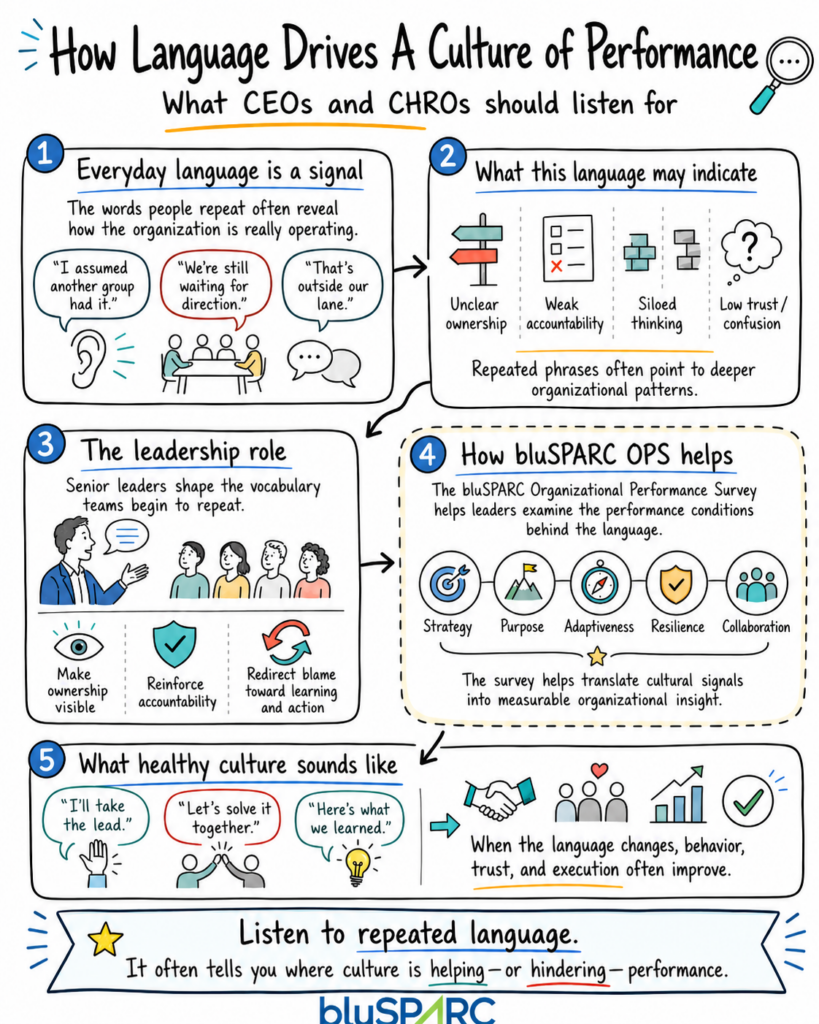
CEO’s CHRO’s and the Executive Teams that listen more closely to the words people use understand that words people reveal the culture before the formal data arrives.
It shows up in meetings, hallway conversations, team updates, project reviews, and the way people explain why something did or did not get done. Long before a survey confirms a pattern, leaders can often hear the culture in the language of the organization.
For CEOs and CHROs, this matters because language is more than communication. It is a window into how people experience clarity, accountability, trust, collaboration, and ownership.
When teams are aligned and healthy, people tend to speak with agency. They talk about solving problems, making decisions, learning from mistakes, and moving work forward. When teams are unclear, frustrated, or fragmented, their language often shifts. People begin to explain, defend, avoid, or distance themselves from the outcome.
A phrase such as “I thought someone else was handling that” may seem harmless in isolation. But when similar phrases repeat across meetings, functions, or levels of leadership, they may be pointing to a deeper issue. The problem may not be effort. It may be unclear ownership. It may not be attitude. It may be weak decision rights. It may not be resistance. It may be that people do not understand how their work connects to the broader strategy.
This is why the language of an organization deserves executive attention.
Language Is Often an Early Performance Signal
At bluSPARC, we believe culture should not be viewed as separate from performance. Culture is one of the ways performance happens. It influences how quickly decisions are made, how effectively teams collaborate, how clearly priorities are understood, and how consistently leaders follow through. Words convey actions. Actions create culture. Culture informs organizational performance.
The bluSPARC Organizational Performance Survey helps leaders examine these performance conditions more intentionally. Rather than treating culture as a general feeling, the OPS looks at the drivers that shape organizational effectiveness, including strategy, purpose, adaptiveness, resilience, and collaboration.
Language often provides early evidence of these same drivers.
When people do not understand the strategy, they speak in competing priorities. When collaboration is weak, teams talk about “they” and “them” more than “we” and “us.” When resilience is low, conversations move quickly toward frustration, blame, or fatigue. When accountability is unclear, people describe work in passive terms, as if outcomes simply happened rather than being owned.
The OPS gives CEOs, CHROs and senior team members a structured way to measure these patterns. The language of the organization gives leaders a real-time way to notice them.
Listen for the Pattern, Not the One-Off Phrase
One defensive comment in a meeting may simply reflect a bad day. Repeated language across teams is different.
When the same types of phrases appear in multiple conversations, they may reveal a systemic issue in clarity, ownership, collaboration, or trust.
Why Senior Leaders Shape the Vocabulary of the Organization
People listen carefully to what senior leaders repeat.
Over time, the words used by the CEO, CHRO, and executive team become more than preferred language. They become cues. They tell the organization what matters, what is safe to discuss, what will be rewarded, and what will be challenged.
If senior leaders consistently ask only for updates, the organization may learn to report activity. If leaders ask who owns the outcome, what decision is needed, and what was learned, the organization begins to think differently about accountability and progress.
This does not mean leaders should script every conversation. It means they should be intentional about the language they model.
A senior leader who wants more accountability cannot rely only on saying, “We need people to be more accountable.” That statement is too broad to change behavior. The leader has to introduce language that helps people practice accountability in real time.
For example, one senior leader we observed began using the phrase, “Who is the single owner of the outcome?” in every major operating discussion. He did not use it as a challenge or a criticism. He used it as a clarifying question.
At first, the team treated the question as administrative. They answered it quickly and moved on. But after several weeks, something shifted. Leaders began arriving at meetings already prepared to name the owner. Cross-functional projects became clearer because people distinguished between contributors, advisors, and decision-makers. Follow-up conversations became more focused because everyone knew who was responsible for moving the work forward.
The phrase worked because it changed the operating expectation. It did not shame people into accountability. It made ownership visible.
Over time, the team began using the phrase without the senior leader prompting it. That is when language becomes culture. A repeated phrase becomes a shared norm.
A shared norm becomes a leadership behavior. Leadership behavior becomes an execution advantage.
Clarity Is Not Confrontation
One reason cultural drift continues is that leaders often avoid clarity because they worry it will feel confrontational. They do not want to sound harsh, overly directive, or critical. As a result, they allow vague commitments to remain vague. However, unclear expectations do not protect relationships. They strain them.
When ownership is not named, people hesitate. When decisions are not clear, execution slows. When accountability is inconsistent, trust erodes. When priorities are competing, teams spend energy negotiating confusion rather than delivering results.
Effective leaders understand that clarity is not the opposite of care. In many cases, clarity is care. It reduces anxiety, prevents rework, and helps people understand what success requires.
This is especially important in complex organizations where work cuts across functions. The more matrixed the organization becomes, the more intentional leaders must be about naming ownership, decision rights, interdependencies, and expected outcomes.
There are a few questions senior leaders can use consistently to strengthen clarity:
- Who owns the outcome?
- What decision needs to be made?
- What does success look like?
- Who else needs to be aligned before we move?
- What did we learn that should change our next step?
These questions are simple, but they are powerful because they move the conversation from activity to accountability.
How Language Connects to the bluSPARC Organizational Performance Survey
The OPS is designed to help leaders understand the conditions that enable or constrain performance. It helps reveal whether people are aligned around strategy, connected to purpose, able to adapt, resilient under pressure, and capable of collaborating across boundaries.
Each of these drivers has a language pattern.
- When strategy is strong, people can explain priorities and make tradeoffs. They do not simply say everything matters. They understand what matters most.
- When purpose is strong, people connect their work to the broader mission of the organization. They understand why their contribution matters beyond the task itself.
- When adaptiveness is strong, people respond to change with curiosity and problem-solving rather than resistance or paralysis.
- When resilience is strong, teams can absorb pressure, learn from setbacks, and continue moving forward without slipping into blame.
- When collaboration is strong, functions do not operate as isolated territories. People use language that reflects shared ownership of enterprise outcomes.
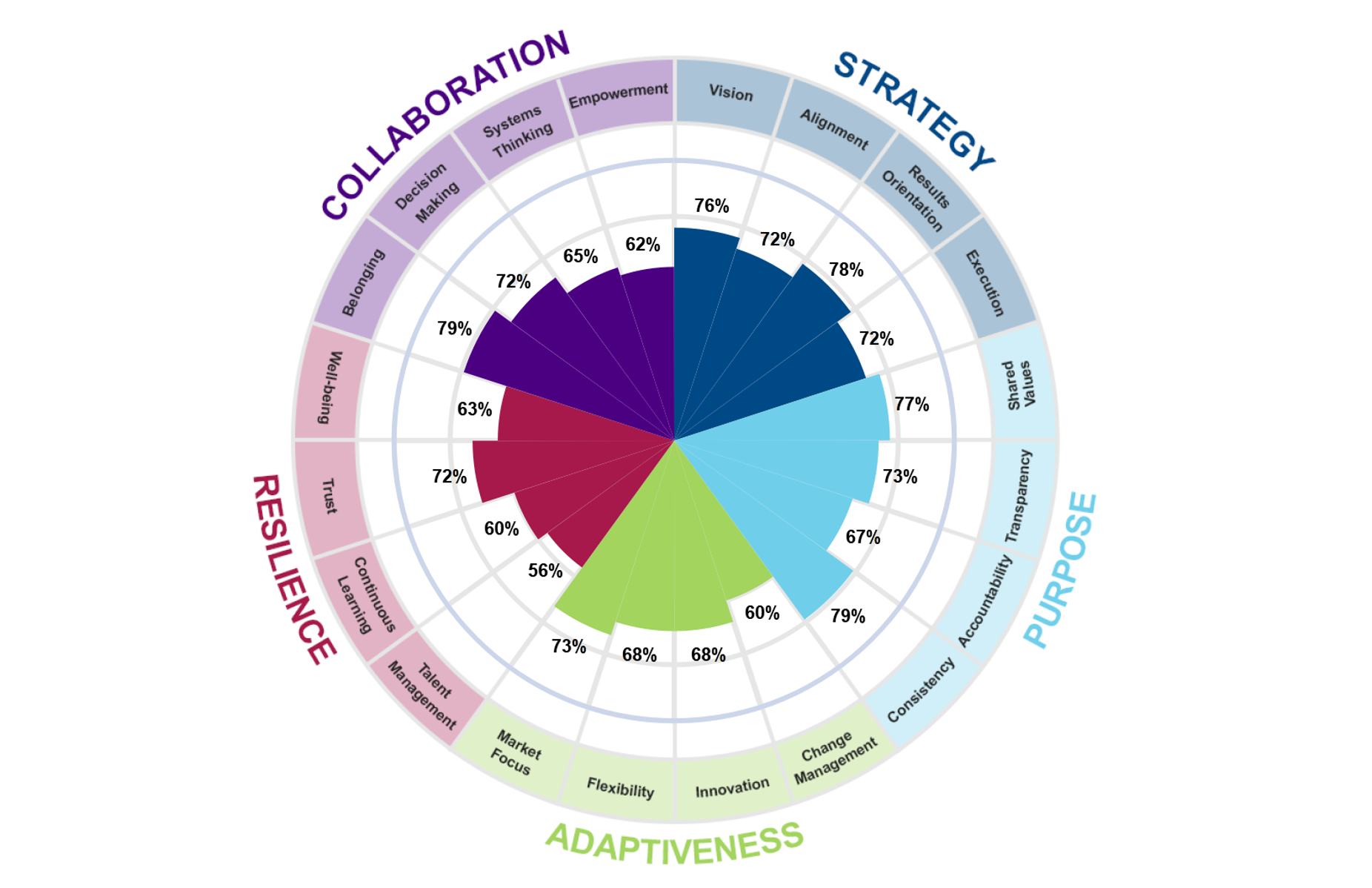
This is where the OPS becomes especially valuable for CEOs and CHROs. It provides a clearer picture of whether the culture people describe is helping or hindering organizational execution. It also helps leadership teams move beyond anecdote.
A CEO may sense that decision-making is too slow. A CHRO may hear that teams are frustrated with cross-functional handoffs. A business leader may notice that people are avoiding ownership. The OPS helps determine whether these are isolated concerns or broader organizational patterns. When paired with what leaders are hearing day to day, the OPS becomes a practical guide for where to focus leadership attention.
What Leaders Should Start Listening For
Senior leaders do not need to overanalyze every word. They do, however, need to become more attuned to repeated patterns.
Listen for whether people describe problems with ownership or distance. Listen for whether teams speak about other functions as partners or obstacles. Listen for whether employees understand the strategy well enough to make decisions without constant escalation. Listen for whether people talk about mistakes as learning opportunities or as threats to be avoided.
The goal is not to police language.
The goal is to understand what the language is revealing.
If people consistently speak in ways that avoid responsibility, the organization may need clearer ownership. If teams use language that separates “us” from “them,” collaboration may need attention. If leaders hear confusion about priorities, strategy may not be translating into daily work. If people avoid naming real issues, trust may be too low for honest dialogue.
A few phrases can be especially useful to watch because they often indicate deeper organizational conditions:
- I am not sure who owns that.
- We are waiting for direction.
- That is really another team’s issue.
- We have too many priorities.
- We keep talking about this, but nothing changes.
These phrases are not failures. They are data. They give leaders a chance to intervene before frustration becomes disengagement or execution drag.
Culture does not change because leaders announce new values. Culture changes when leaders consistently reinforce new expectations through language, decisions, recognition, and accountability.
If CEOs and CHROs want stronger ownership, they must make ownership visible. If they want better collaboration, they must challenge language that reinforces silos. If they want greater resilience, they must normalize learning rather than blame. If they want faster execution, they must clarify decision rights and priorities.
The most effective leaders use language as a leadership tool. They repeat the words and questions that focus attention on what matters most.
Over time, those words shape conversations. Conversations shape behavior. Behavior shapes performance.