
One of the most significant transitions in a leader’s career is not earning a promotion or receiving a seat at the executive table. It is the moment when success is no longer measured by the performance of one function, but by the success of the entire organization.
Many executives arrive at this point because they have mastered their discipline. They have delivered exceptional results, built high-performing teams, solved complex problems, and become trusted experts within their function. Those accomplishments earned them the opportunity to lead at a higher level.
Yet many discover that the rules have changed. The conversations are broader. The tradeoffs are more complex. The questions are different. Technical expertise remains valuable, but it is no longer enough.
This is the transition from functional leadership to enterprise leadership.
The Three Levels of Leadership
Most leaders progress through three distinct levels of leadership.
- Functional Leadership focuses on achieving results within one’s department. Leaders optimize their team’s performance, develop talent, solve operational problems, and execute against functional objectives.
- Cross-Functional Leadership broadens that perspective. Leaders collaborate across departments, manage competing priorities, and recognize how their work influences other parts of the organization.
- Enterprise Leadership represents another level altogether. Enterprise leaders view the organization as an interconnected system. Every decision is evaluated according to its impact on strategy, customers, employees, operations, financial performance, innovation, risk, and long-term organizational success. At this level, leadership is no longer about optimizing one function—it is about strengthening the enterprise.
What Is Enterprise Leadership?
Enterprise leadership is the ability to understand the organization as an integrated system and consistently make decisions that create value for the enterprise rather than a single function.
Enterprise leaders remain experts in their discipline, but they no longer think only through the lens of their discipline. They ask better questions, anticipate broader implications, and balance competing priorities with the organization’s long-term success in mind.
The most effective executive leadership teams are not simply collections of functional experts. They are enterprise leaders who think collectively about what is best for the organization.
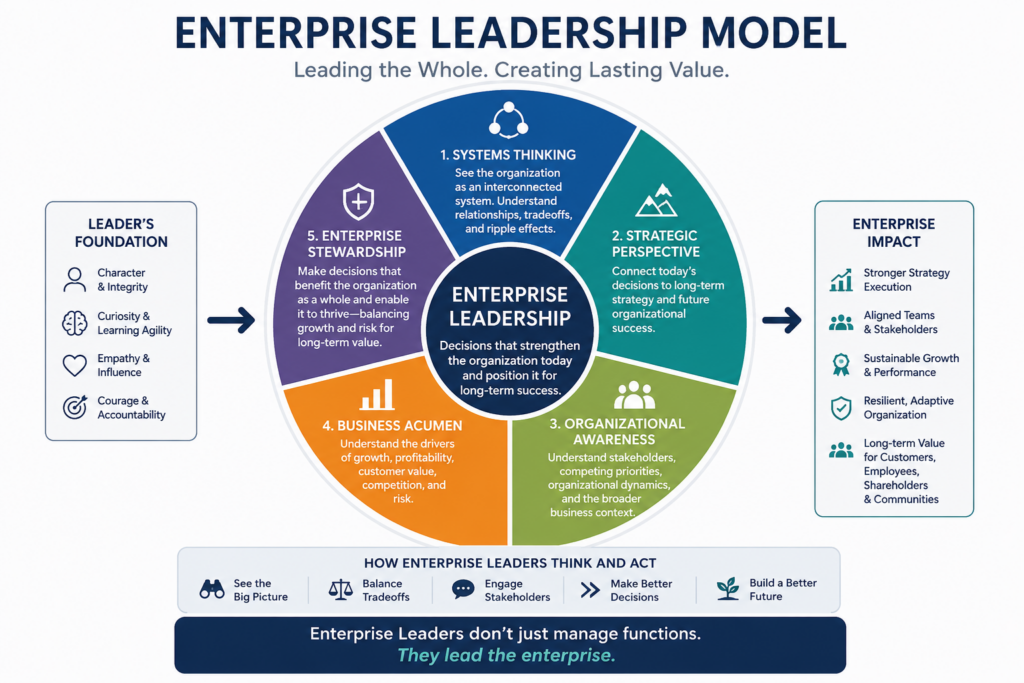
The Five Dimensions of Enterprise Leadership
Although enterprise leadership looks different across organizations, five capabilities consistently distinguish executives with an enterprise leadership mindset.
1. Systems Thinking
Definition: Systems thinking is the ability to understand how actions in one area create consequences throughout the organization.
Why It Matters: Organizations operate as interconnected systems. A decision in Sales affects Operations. Operations influence Customer Experience. Customer Experience impacts retention, profitability, and ultimately future investment.
Enterprise leaders recognize that many challenges appearing in one department are actually symptoms of issues originating elsewhere.
What It Looks Like: Rather than solving isolated problems, enterprise leaders consider the ripple effects of every significant decision before acting.
Questions an Enterprise Leader Asks:
- How will this decision affect other functions, and what second- or third-order consequences should we anticipate?
- Where are the organizational dependencies that could either accelerate or prevent successful execution?
2. Strategic Perspective
Definition: Strategic perspective is the ability to connect today’s decisions with the organization’s long-term direction.
Why It Matters: Enterprise leaders understand that short-term success should never come at the expense of long-term capability. Every investment, initiative, and priority should advance the organization’s future position.
What It Looks Like: Enterprise leaders continually evaluate decisions through the lens of growth, competitive advantage, innovation, and long-term sustainability.
Questions an Enterprise Leader Asks:
- How does this initiative move us closer to our three- to five-year strategic objectives?
- If we invest our resources here, what opportunities are we choosing not to pursue?
3. Organizational Awareness
Definition: Organizational awareness is understanding stakeholders, competing priorities, organizational dynamics, and the informal networks that influence execution.
Why It Matters: The best strategies fail when leaders overlook stakeholder alignment. Enterprise leaders appreciate the different pressures experienced across functions and proactively build commitment before major initiatives begin.
What It Looks Like: Enterprise leaders spend as much time building alignment as they do making decisions.
Questions an Enterprise Leader Asks:
- Which stakeholders are most affected by this decision, and how can we gain their commitment early?
- Where might competing priorities create friction, and what alignment needs to occur before we move forward?
4. Business Acumen
Definition: Business acumen is understanding how the organization creates value for customers while generating sustainable financial performance.
Why It Matters: Enterprise leaders recognize that every function contributes to organizational success. Whether leading Human Resources, Legal, Finance, Technology, Marketing, or Operations, executives must understand the business drivers behind growth, profitability, customer value, competition, and enterprise risk.
What It Looks Like: Enterprise leaders naturally connect functional decisions to broader business outcomes.
Questions an Enterprise Leader Asks:
- How will this decision improve customer value, organizational performance, or long-term profitability?
- What are the financial, operational, or competitive risks if we act—or if we choose not to act?
5. Enterprise Stewardship
Definition: Enterprise stewardship is the responsibility to make decisions that strengthen the culture of the organization as a whole rather than optimizing one function.
Why It Matters: Enterprise leaders recognize they are stewards of the organization’s future. Their role extends beyond protecting their department. They create conditions that enable the organization to grow, innovate, adapt, and succeed over time.
What It Looks Like: Enterprise leaders willingly make difficult tradeoffs when those decisions create greater value for the enterprise.
Questions an Enterprise Leader Asks:
- What decision creates the greatest long-term value for the enterprise, even if it requires compromise from my function?
- Will this choice leave the organization stronger, more capable, and better positioned for future success?
Seeing the Organizations from an Enterprise Perspective
Enterprise leaders need more than broad perspective, they need a framework for seeing the organization as an interconnected system. The bluSPARC Organizational Performance Survey (OPS) provides that lens. By examining Strategy, Purpose, Adaptiveness, Resilience, and Collaboration together, OPS helps executive teams identify where strengths exist, where gaps are emerging, and how decisions in one area affect performance across the enterprise. Rather than optimizing individual functions, leaders begin optimizing the entire organization.
What Enterprise Leadership Looks Like in Practice
Consider a Vice President of Product who has built a reputation for launching innovative products and responding quickly to customer feedback. Early in their career, success was measured by delivery speed, product quality, and adoption metrics.
As they move into an enterprise leadership role, however, their perspective expands. They begin asking different questions:
- How will this investment affect profitability?
- Can Operations support the launch?
- How will Customer Success, Sales, and Marketing be impacted?
- Are we solving the right customer problem, or simply building another feature?
The focus shifts from creating the best product to creating the greatest enterprise value.
The same transition occurs in Human Resources.
A Chief Human Resources Officer may initially focus on recruiting, engagement, leadership development, and culture. As an enterprise leader, the conversation broadens. Instead of asking, “How do we improve engagement?” the question becomes:
- What workforce capabilities will our strategy require over the next three years?
- How can talent accelerate innovation, execution, and growth?
- Where are the organizational risks that could prevent us from achieving our strategic objectives?
Talent is no longer viewed as an HR initiative. It becomes an enterprise capability.
In both examples, the leaders do not abandon their functional expertise. They expand it. Their perspective shifts from optimizing a department to strengthening the enterprise.
One Final Observation
One of the easiest ways to recognize an enterprise leader is not by listening to the answers they provide, it is by listening to the questions they ask.
Functional leaders naturally ask questions that optimize their department.
Enterprise leaders ask questions that optimize the organization. Over time, those questions shape better conversations, better decisions, stronger executive teams, and ultimately, more successful organizations.
Final Thoughts
Enterprise leadership is not defined by title or organizational hierarchy. It is defined by perspective.
Organizations need executives who can connect strategy, people, operations, customers, innovation, and risk into one coherent picture. They need leaders who think beyond functional excellence and make decisions that strengthen the enterprise as a whole.
The executives who make this transition successfully do not stop being experts in their discipline. They simply learn to see the organization through a much wider lens.
In today’s increasingly complex business environment, that ability may be the defining leadership capability of the next generation of executive leaders.